
Geothermal district heating and cooling in the Pleyel district of Saint-Denis
Overview
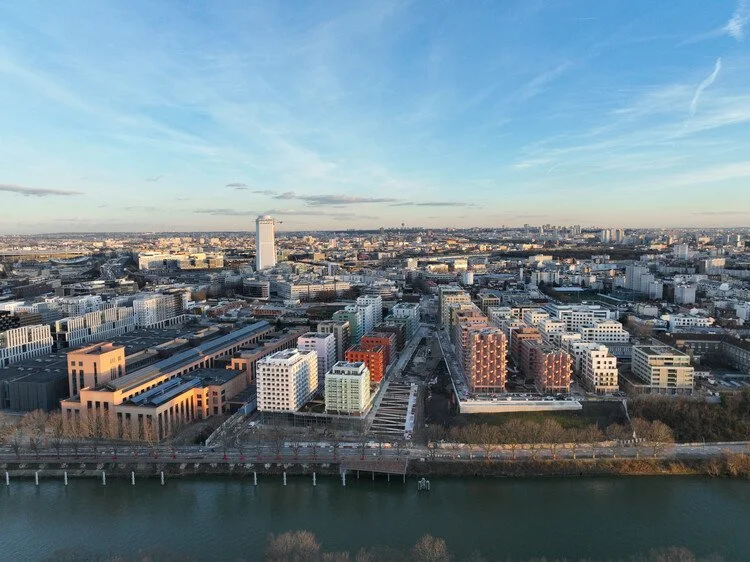
The Pleyel district in Saint-Denis, near Paris, is one of the clearest examples of how geothermal energy can support sustainable cooling in dense urban areas. The area hosted the Olympic and Paralympic Village for Paris 2024, and the geothermal system developed there now remains part of the district’s long-term energy infrastructure.
The system was designed to provide renewable heating, domestic hot water and cooling to the Village and the surrounding district. Today, the same infrastructure continues to supply homes, offices and public buildings with local renewable energy, showing how geothermal energy can support both immediate urban needs and long-term climate objectives.
The geothermal plant uses very low-temperature geothermal energy. Water is drawn from underground at a stable temperature of around 14°C through 11 geothermal wells, drilled between 50 and 70 metres deep. The water is then connected to reversible heat pumps, which produce both hot and cold water for the district network.
In summer, the system produces chilled water for cooling buildings. In winter, the same geothermal resource supports heating and domestic hot water. This makes the Pleyel network a strong example of how geothermal energy can respond to both rising cooling demand and the need to decarbonise heating.
The system is now connected to around 600,000 m² of buildings in the Pleyel district, including the former Olympic and Paralympic Village, the Tour Pleyel and the Lumières Pleyel development.
Investments
June 2020: tripartite agreement between Solideo, Smirec and Engie.
November 2022: start of the geothermal plant construction.
End of 2023: geothermal power plant fully operational (start of production already mid-2023).
The impact on CO2 emissions and climate
The Pleyel district in Saint-Denis is using geothermal energy to support a more sustainable urban energy system. The network provides renewable heating, domestic hot water and cooling to homes, offices and public buildings, using local underground energy instead of relying only on conventional heating and cooling systems.
The geothermal network supplies around 600,000 m² of buildings in the district. It provides 68% renewable energy through geothermal energy and avoids around 4,747 tonnes of CO2 emissions each year.
Summary
Depth of drilling: ~ 50 - 70 m
11 boreholes
Heat pump output: cold water at 5°C and hot water at 65°C
Geothermal power: 4 MW of heating and 2 MW of cooling
Temperature of the water drawn: ~ 14 degrees
Units covered: Olympic Village: 52 hectares or the equivalent of 70 football pitches, which will be home to over 14,000 athletes during the Games.
Total amount of investments: EUR 27 million
CO2 emissions avoided: 4,500 tonnes of CO2 per year