
Shallow Geothermal Applications in the Heart of Renaissance Florence
Florence's old town, with its priceless cultural and historical significance, is now a special stage for 21st-century energy challenges. To this day, investments in shallow geothermal energy have been made to heat and cool the impressive buildings. This effort demonstrates that such geothermal projects are not only feasible but also particularly beneficial for the Tuscan capital.
Project Basis and Financing
The sites of the geothermal projects are the museum complex being built next to Florence Cathedral and the Basilica of Santa Croce. While the latter is a state-owned and maintained building, the Cathedral and other related cultural units have been in the hands of a private company, Opera di Santa Maria del Fiore, since 1296 (!), and their maintenance differs from that of other Renaissance urban buildings. Unlike the Basilica of Santa Croce, the cost of renovations to the Cathedral Museum is largely covered by income from admission tickets to the building complex.
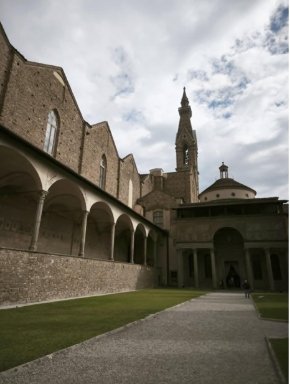
The garden of Basilica Santa Croce (Picture: Jenei Ákos Zoltán)
Hydrogeological conditions
Based on scientific analyses, in downtown areas, including the Palazzo Compagni and Santa Croce neighbourhoods, the geological structure consists of Holocene alluvial-newer sediments, which mainly contain gravel with a silty-sandy matrix, river terrace gravel, sand and silt (from approximately 2.4 m to 15-18 m, according to a 2025 measurement) directly beneath the surface. In the drilling area, the bedrock is located at a depth of 25 m, while the groundwater level is 7-8 m below ground level. The proximity of the drilled wells to the Arno River (700 m) ensures adequate replenishment and stable hydraulic conditions.
In terms of environmental impact, both projects comply with current legislation: the maximum change in hydraulic load is only 0.2 m for the wells drilled at the Dôme Museum and only 0.02 m for the Basilica of Santa Croce. The temperature change resulting from reinjection, which varies between winter and summer, is expected to be no more than 5°C. According to calculations, the energy used for heating in winter is almost 100% replenished in summer from the condensation heat of the heat pump
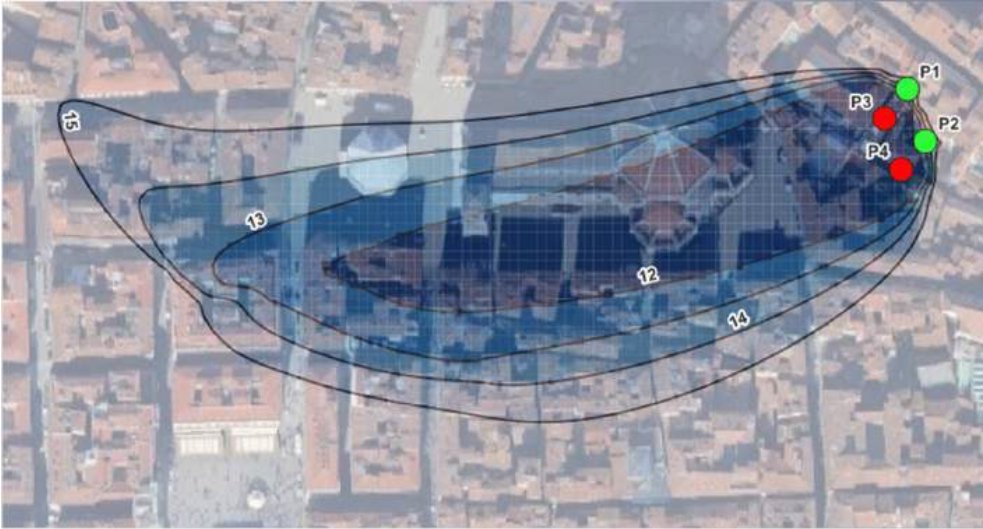
Model calculation results for winter operating conditions (Picture: Alessandro Murratzu)
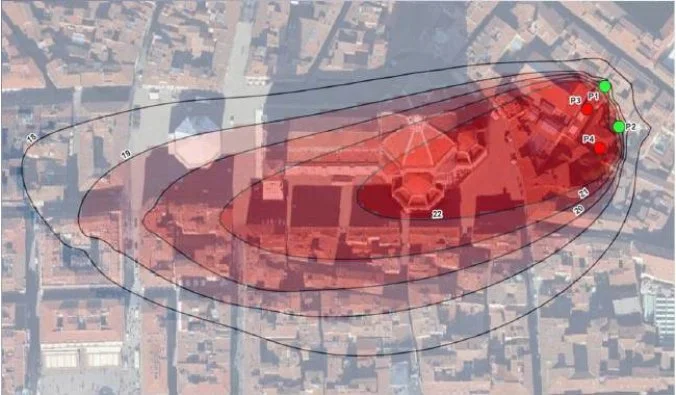
Model calculation results for summer operating conditions (Picture: Alessandro Murratzu)
Completed projects
Both the Dome Museum and the Basilica of Santa Croce have been equipped with open-loop, low-temperature geothermal systems suitable for both heating and cooling. These (shallow geothermal) systems use the temperature of groundwater (or other aquifers) near the Earth's surface as a direct heat source or heat sink and operate through pairs of wells: one extraction well and one reinjection well. After extraction, the groundwater first enters a heat exchanger, which is connected to the evaporator or condenser of the heat pump, depending on the operating purpose.
Two pairs of wells were installed at the Dome Museum, capable of heating and cooling the building complex's 3,500 m² floor space and 15,000 m³ of air volume. The three built-in heat pumps have a total nominal heating capacity of 765.3 kW and a cooling capacity of 762.6 kW. The coefficient of performance (COP) is 4.2, and the energy efficiency index is 5.6.
Permission had to be obtained from the authorities to start the project. To obtain permission, a soil survey was conducted, using a mathematical model to demonstrate that the new wells would not adversely affect the hydrogeological and geotechnical structure beneath the building complex. The authorities issued the permit within three months of the application being submitted.
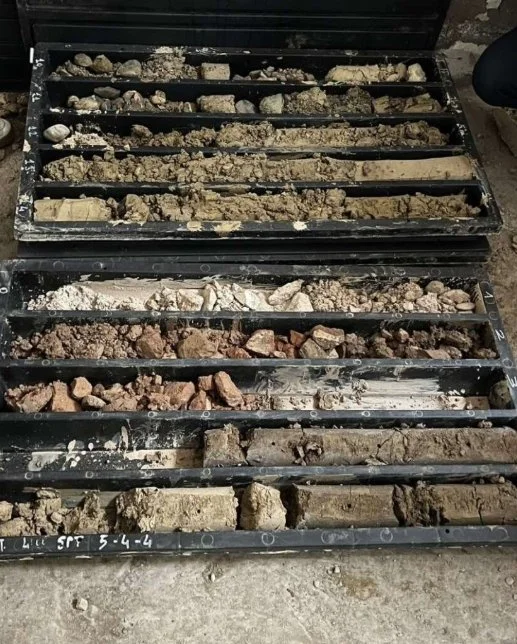
Drilling layer sequence (Picture: Jenei Ákos Zoltán)
Advantages and disadvantages – Why is it worth it?
In addition to the undeniably important environmental and sustainability considerations, several other factors also played a role in implementing the Florence investments.
First and foremost, the heating and cooling systems installed have favourable efficiency indicators, which means building operators can expect very low energy consumption and operating costs. According to calculations conducted at the Dome Museum, cost savings of up to 70-80% can be achieved compared to traditional natural gas-based heating. A comparison with air-to-water heat pump solutions shows that water-to-water heat pumps consume 80 MWh less electricity per year, saving operators around €25,000 in maintenance costs. Thanks to the energy generated in this way, these buildings fall into the "renewable" category according to the European Union directive classification.
A disadvantage is the higher installation cost compared to air-to-water heat pump systems and hybrid systems consisting of gas boilers and air-to-water liquid coolers, as well as the fact that in open-loop systems, there is often no suitable aquifer in the soil beneath the ground.
The temperature of groundwater remains relatively stable throughout the year, providing a reliable, constant heat source for winter heating and summer cooling. Compared to air-water heat pumps, significant electricity savings can be achieved through higher energy efficiency, especially in colder climates. In contrast, the performance of air-to-water heat pumps can drop by up to half in climates colder than 0°C, not to mention the possibility of operational failures.
Open-loop systems use groundwater as a heat exchanger, but after heat transfer, the water is completely returned to the same layer, with no change in volume or chemical composition. This ensures that the project does not overload local water resources or pollute groundwater. However, open-loop systems have another advantage that is essential for cities this rich in history, such as Florence: the installation is very "discreet," allowing heat pump equipment to be compact and wellheads to require minimal surface intervention. Their operation is essentially silent, which is an important consideration in densely populated areas such as Florence's old town. In our case, thick layers of historical remains from earlier periods, including medieval and Roman building debris, can be found beneath the Tuscan capital, so it is crucial that the impact on these monuments is kept to a minimum.
Conclusion
The projects outlined in Italy are not only beneficial from an environmental and financial perspective, but also serve specific needs, such as adapting to densely populated urban locations and outstanding historical environments.
Technical Details
Cooling and heating performance of one tested heat pump
Nominal cooling capacity - 254,2 kW
Nominal heating capacity - 255,1 kW
Electrical power input - 61,1 kW
Coefficient of Performance (COP) - 4,2
Temperature change resulting from reinjection: no more than 5°C
The energy used for heating in winter is almost 100% replenished in summer from the condensation heat of the heat pump
Sources:
Alessandro Murratzu, Geologist Technical Manager, IdroGeo
Sergio Giuseppini, Engineer, STIMP Srl.
With thanks to the original author, Ákos Jenei, Italy