
Geothermal heating and cooling at Kraftwerk Seebogen in Vienna
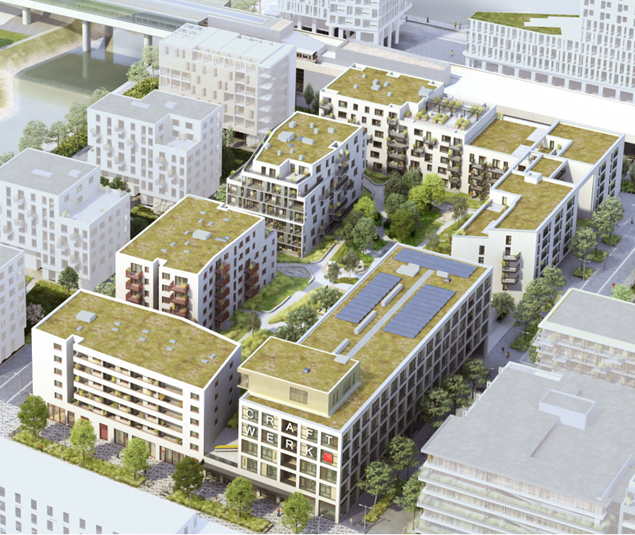
Overview
In Vienna, the Kraftwerk Seebogen project shows how shallow geothermal energy can provide heating, cooling and domestic hot water for a modern urban development.
Located at Eileen-Gray-Gasse in Vienna, the project supplies residential and commercial buildings covering around 18,000 m². The geothermal system was commissioned in 2022 and was developed with the objective of supplying the properties with renewable energy while avoiding CO₂ emissions during operation.
The decision to use geothermal energy was also driven by the opportunity to make full use of the energy resources available on site, creating a local solution capable of meeting heating and cooling needs from the same infrastructure.
A closed-loop geothermal solution
The system uses closed-loop borehole heat exchangers, with boreholes reaching a depth of 150 metres.
Geothermal energy supports all three of the development’s main thermal needs: space heating, cooling and domestic hot water. The reported demand amounts to 615 MWh for heating, 220 MWh for cooling and 540 MWh for hot water.
The system extracts around 660 MWh of energy from the ground, while approximately 220 MWh is returned or injected.
An additional source heat-exchanger system helps balance the geothermal field by transferring heat between the outside air and the geothermal probes. This allows the different energy sources available at the site to work together and supports the long-term operation of the system.
Geothermal as part of a low-carbon urban energy system
Kraftwerk Seebogen was conceived around the goal of supplying buildings without CO₂ emissions during operation. The heating and cooling system relies on renewable energy sources, combined with renewable electricity for the operation of the installation.
By integrating heating, cooling and domestic hot water into a single energy concept, the project illustrates how geothermal heat pumps can support the decarbonisation of modern residential and commercial developments in growing urban areas.
The project also demonstrates that geothermal systems can be integrated into new buildings without adding complexity for their users. Beyond Carbon Energy describes both the installation and day-to-day operation of the system as straightforward, with the main operational consideration being the balancing of the geothermal probes and source heat exchangers.
Summary
Location: Eileen-Gray-Gasse 5–7, Vienna, Austria
Project: Aspern H6 – Kraftwerk Seebogen
Building type: New residential and commercial development
Area supplied: approximately 18,000 m²
Technology: Closed-loop geothermal heat pump system
Commissioned: 2022
Borehole depth: 150 m
Services: Heating, cooling and domestic hot water
Heating demand: 615 MWh
Cooling demand: 220 MWh
Water demand: 540 MWh
Energy extracted: 660 MWh
Energy returned/injected: 220 MWh
COP/SPF: 3.9
Financing: Partially funded